




When procurement managers evaluate packaging solutions for sensitive equipment, medical instruments, or specialized tools, a common dilemma arises: why do items identical in appearance perform differently under stress? Many buyers focus primarily on unit prices, neglecting technical variables like material density, interior structural design, and manufacturer quality control systems. This narrow focus often results in transit damage to high-value contents, even when stored inside a protective shell. In the specialized manufacturing sector, choosing a high quality shockproof EVA carry case supplier requires a shift from superficial cost analysis to deep technical verification.
Ethylene-Vinyl Acetate (EVA) has become a preferred material for protective packaging due to its lightweight nature and structural stability. However, the performance of the final product depends heavily on raw material grade and the precision of the thermoforming process. As an established high quality shockproof EVA carry case supplier, DongYang YiRong Luggage Co., Ltd. demonstrates how technical variables differentiate specialized protection from generic packaging.
Material Density and Structural Resilience: Molded EVA vs. Soft Bags
Traditional soft fabric bags or lightweight injection-molded boxes present clear limitations when protecting precise technical instruments. Fabric bags lack structural stiffness, leaving contents vulnerable to external crushing forces. Conversely, standard injection boxes can be heavy and brittle under impact. Molded shockproof EVA carry case alternatives bridge this gap by combining rigidity with energy absorption.
A common structural failure in low-grade EVA cases is the tendency to collapse under load. This happens because some suppliers use low-density EVA foam sheets to reduce raw material costs. When subjected to pressure, these materials undergo permanent deformation. DongYang YiRong Luggage Co., Ltd. addresses this issue by utilizing high-density, closed-cell EVA formulas. Under high-temperature compression molding, these materials form a resilient, rigid shell that retains its shape under stress.
Manufacturing hardware also directly influences the structural uniformity of the final product. YiRong Luggage operates 15 automated compression molding machines within its facility. This infrastructure ensures even temperature distribution and balanced pressure application across the entire mold surface during production. Uniform compression prevents localized weak spots, giving each shockproof EVA carry case balanced impact resistance across its corners and edges.
Surface Engineering and Interior Stabilization
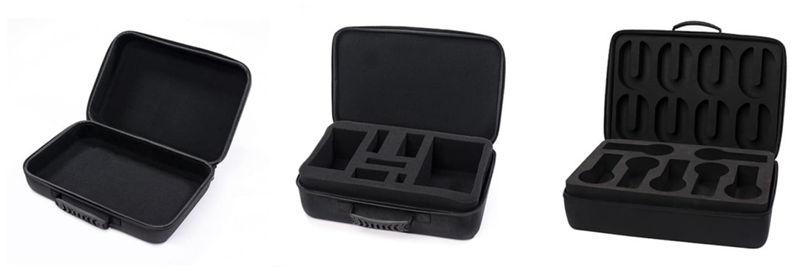
The functional capabilities of a protective case depend greatly on its external textile laminate and internal buffering configuration. The exterior layer provides the initial defense against friction, moisture, and environmental exposure. While basic options on the market often feature thin, non-woven fabrics that wear out quickly, industrial-grade applications demand stronger materials. Depending on deployment needs, premium outer layers include 1680D ballistic nylon or carbon-fiber texture PU. These materials offer enhanced abrasion resistance and water-repellent properties, maintaining case integrity over extended field use.
Inside the case, internal stabilization prevents internal components from shifting during transit. Generic cases often feature thin foam sheets or basic grid cloth, which offer minimal absorption against sudden drops. Effective shock mitigation requires customized interior engineering. Experienced fabricators design target-specific internals, such as egg-crate foam for delicate electronics, custom-routed rigid EVA cutouts for mechanical tools, or adjustable hook-and-loop dividers for adaptable medical kits. These configurations cradle components securely, decoupling the payload from external physical shocks.
Sourcing Architecture: Direct Factory vs. Intermediary Trading Entities
The organizational structure of the supply chain affects product consistency, lead times, and regulatory compliance. Procurement teams often choose between direct-to-factory partnerships and third-party trading intermediaries. While intermediaries offer broad portfolios, their outsourced production model can introduce variables in delivery timelines and quality control.
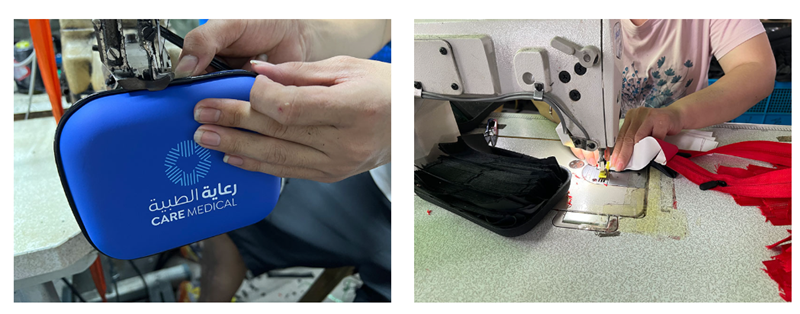
Direct source factories handle manufacturing scale and scheduling transparency differently than trading entities. Regarding production capacity, intermediary entities remain dependent on external sub-contractor scheduling, whereas DongYang YiRong Luggage Co., Ltd. coordinates 15 molding machines and 5 sewing lines to achieve a daily output of up to 10,000 pieces, guaranteeing clear delivery timelines for volume orders.
Design integration also differs, as intermediaries rely on multi-tier communication that can cause layout delays, while direct factory R&D teams utilize Pro/E, SolidWorks, and AutoCad systems to interface directly with client CAD data, creating precise 3D models before cutting tooling. Finally, regarding compliance tracking, regulatory documentation from trading firms can be variable depending on changing suppliers, whereas a direct factory provides consistent monitoring with available RoHS, REACH, and CA65 verification reports.
Framework for Procurement Evaluation
Industrial buyers can systematic qualify potential manufacturing partners by focusing on three technical criteria:
• Shell Resilience Verification: Assess the rebound performance of the thermoformed outer shell under localized pressure. High-density EVA formulas quickly regain their shape without creasing.
• Interior Customization Capability: Evaluate whether the supplier can engineer multi-layered, variable-density internal cushioning tailored to specific product geometries.
• Compliance and Infrastructure Audit: Review the factory’s machinery assets and verified third-party material certifications, confirming compliance with international environmental directives like RoHS, REACH, and California Proposition 65.
Aligning with an OEM/ODM provider that integrates these capabilities helps enterprises mitigate transit damage risks and safeguard product performance in the field.
Technical Sampling and Implementation
Validating custom protective packaging requires precise physical testing. YiRong Luggage, established in 2014, provides an engineering path from conceptual design to verified physical samples. For early-stage verification, procurement teams can request free reference samples from the company’s library of existing molds to evaluate material densities and surface finishes.
When custom geometries are required, the technical team creates prototypes tailored to specific equipment dimensions. The standard development cycle for custom prototypes spans 7 to 10 days, allowing for comprehensive drop testing and fitment reviews before committing to volume production. The factory supports scalability by maintaining a minimum order quantity (MOQ) of 500 pieces per run, ensuring a balanced transition from prototype validation to volume manufacturing.
To learn more about material options, custom interior designs, or to submit technical drawings for engineering review, please visit the official website: https://www.dyyrevacase.com/.
Post time: Jun-24-2026