




Drone & Aerial Equipment EVA Cases: A B2B Sourcing Guide for Drone Brands, Importers and Survey Teams
The global commercial drone market has moved well beyond hobbyist toys. Enterprise fleets used for land surveying, power-line inspection, precision agriculture and public-safety operations now ship with thousands of dollars of sensitive electronics per unit, and every drone brand, AV equipment importer and e-commerce seller faces the same problem: how to transport remote controllers, intelligent flight batteries, spare propellers, payload modules and cables without damage, loss or fire risk. A generic backpack or a foam-lined carton is no longer acceptable for B2B buyers who expect consistent protection across hundreds of shipments. This guide walks procurement managers, private-label drone brands and survey-team equipment leads through the practical specifications that separate a reliable drone EVA case from a purely cosmetic one.
Why Drone Gear Needs Purpose-Built EVA Cases
A drone kit is a collection of fragile, expensive and oddly shaped components. A typical consumer or prosumer combo includes a folding airframe, a remote controller with an integrated screen, three to six intelligent batteries, a multi-bay charger, spare propeller pairs, ND filters, a landing pad and assorted cables. Total replacement value for a single prosumer setup routinely falls between USD 1,500 and USD 6,000, while a survey-grade payload kit can exceed USD 20,000. When these items rattle against each other inside a soft bag, the first casualty is usually the gimbal or the controller screen. The core value of a well-engineered partitioned fixing layout is that every component has a defined home, so field teams can verify completeness in under thirty seconds before and after a mission.
Compared with injection-molded hard cases, EVA cases offer a lighter carry weight, typically 18% to 35% lighter at the same internal volume, a softer exterior that resists scuffing on vehicle interiors, and a lower unit cost at mid-volume orders. Compared with soft bags, they hold a rigid shape and protect against side compression. For drone brands building a private-label accessory line, EVA also prints and debosses cleanly, which matters for brand consistency across an entire product family. The trade-off is that EVA cannot match a hard case in deep-submersion sealing or extreme crush resistance, so the specification decision should follow the actual transit and field environment rather than a generic “toughest possible” reflex.
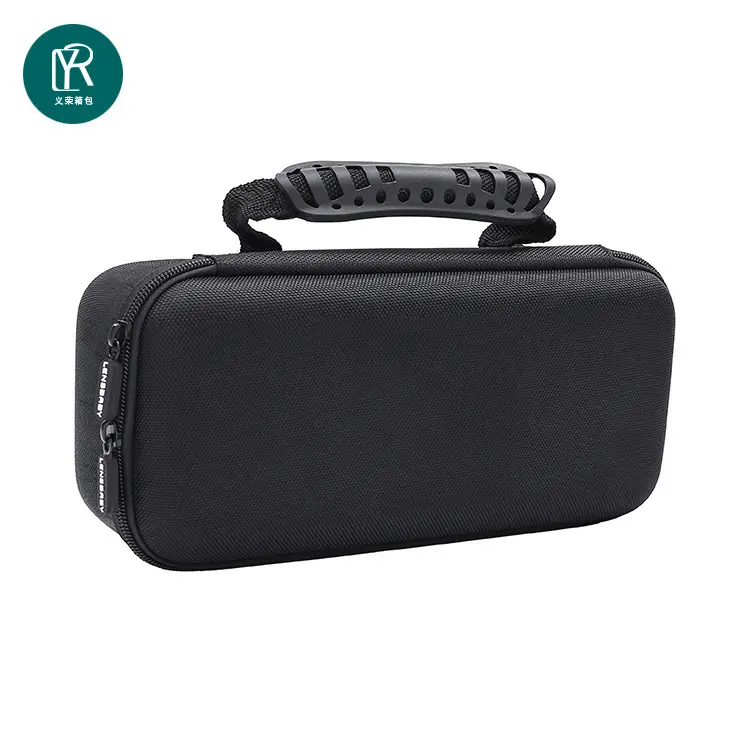
Partitioned Fixing Design for Remote Controllers, Batteries and Propellers
The first design decision is how to divide the internal volume. A practical drone case layout for a prosumer quadcopter usually allocates space in this order of priority, based on fragility and frequency of access:
- Remote controller bay: a contoured cradle that holds the controller screen-up or screen-down with 8 mm to 12 mm of wall clearance, plus a small pocket for spare sticks or a neck lanyard.
- Battery row: individual finger-grip channels sized to the battery’s exact outline with 2 mm to 3 mm tolerance, so cells cannot slide and short against each other during transit.
- Propeller compartment: a flat, dedicated layer with elastic straps or die-cut slots for folded propeller pairs, kept physically away from the controller screen.
- Accessory lane: a zippered mesh pocket or a slim EVA tray for the charger, cables, ND filters and spare memory cards.
- Airframe bay: a larger contoured recess for the folded drone body, often with a removable divider to convert the case from single-unit to dual-unit use.
For buyers specifying at volume, request a CAD-based layout drawing before any tooling is cut. A good supplier will return a 2D cavity map showing every pocket, its depth and its clearance, so you can validate fit against your actual SKUs rather than against a generic template. Expect to pay a small engineering fee, typically USD 50 to USD 200, for this drawing on a custom program; it is money saved many times over by avoiding a wrong first tool.
CNC-Cut vs Molded EVA Inserts: What B2B Buyers Should Know
The interior that holds your gear can be produced two fundamentally different ways, and the choice drives cost, lead time and long-term flexibility. Understanding both prevents costly mid-program redesigns.
CNC-Routed Inserts
A CNC-routed EVA insert starts from a solid block or laminated sheet of EVA foam, typically 25 mm to 60 mm thick, that is milled on a router table to the exact cavity shape. Advantages for B2B buyers include low minimum order quantities, often 100 to 300 units for a custom cavity, fast iteration when your product dimensions change, and the ability to cut very tight tolerances of plus or minus 0.5 mm. The trade-off is a higher per-unit insert cost at scale and visible routing marks that need light sanding or a top laminate on premium lines. For a launch with uncertain volume, CNC routing is almost always the lower-risk starting point.
Molded Inserts
A molded insert is produced by compressing EVA or a PE/EVA blend in a heated tool, yielding a one-piece contoured tray with a smoother surface and lower unit cost once the tool is amortized. Tooling typically runs USD 800 to USD 3,500 depending on cavity complexity, with a lead time of 18 to 35 days for the first shots. At orders above roughly 2,000 units, molded inserts usually win on unit economics, but they lock you into fixed dimensions until you re-cut the tool. Plan a tool-maintenance clause in your supply agreement so cavity wear after 20,000 to 50,000 shots does not silently change your fit.
For most private-label drone brands launching a new airframe, the pragmatic path is a CNC-routed insert for the first 500 to 1,500 units to validate the market, then convert to a molded insert for the steady-state volume. This staged approach keeps upfront tooling spend under control while preserving fit quality, and it lets you incorporate real-world field feedback before committing to a hard tool.
Fire-Resistant and Thermal Isolation for Battery Storage
Lithium-polymer and lithium-ion intelligent batteries are the single highest-risk item in any drone kit. While no soft-sided case is a certified fire-safe enclosure, B2B buyers should specify materials and construction that reduce risk during transit and storage. Consider these concrete measures when writing your specification:
- Use a fire-retardant lining rated to a recognized standard such as UL 94 HF-1 or CPAI-84 for the battery chamber, even if only as an inner sleeve rather than the whole case.
- Separate each battery in its own finger channel so terminals cannot contact, and add 1.5 mm to 2 mm of closed-cell foam between adjacent cells.
- Specify a vented or breathable battery pocket for thermal dissipation during short-term storage, while keeping the overall case sealed against dust ingress.
- Require a flame-retardant document sleeve holding safety cards and a battery transport declaration for air-freight compliance and field audits.
Note that regulations for shipping lithium batteries by air, including IATA Dangerous Goods and UN 3480 or UN 3481, remain the responsibility of the shipper. The case is a protective layer, not a substitute for compliant packaging and labeling. Discuss your destination markets with the supplier so the lining choice supports the declarations you will file, and keep a paper trail of the material certifications for customs and insurance purposes.
Shock Absorption Grades and ISTA Transit Protection
Drop and vibration protection is where drone cases earn their keep. For B2B shipments that move through courier networks and airline cargo, specify an ISTA 3A drop-test protocol as the acceptance benchmark. A representative test drops the packed case from heights of 460 mm to 710 mm depending on mass, across bottom, side, edge and corner orientations, then inspects for component shift and foam compression set. Some buyers also request ISTA 1A for packaged-products vibration to simulate long-haul trucking.
Practical foam specifications to request from your supplier:
- Top and bottom lining in 20 mm to 30 mm of 35 kg/m³ to 45 kg/m³ density EVA for general cushioning of shells and chargers.
- Critical components such as the gimbal and controller screen backed by 8 mm to 12 mm of high-rebound 60 kg/m³ to 75 kg/m³ EVA or a PU-padded panel.
- Compression set below 8% after 22 hours at 70°C, per ASTM D395, so the foam does not permanently flatten after repeated load cycles.
- Shell EVA thickness of 4 mm to 6 mm for mid-size cases, rising to 5 mm to 7 mm for cases holding more than 8 kg of gear or built for fleet trolleys.
Buyers running their own inbound QC should photograph the foam after a 1.2 m drop and measure cavity displacement; a well-designed insert keeps every component within 3 mm of its molded position. Document this as a receiving inspection so a sub-standard batch is caught before it reaches your customer or your field team.
Waterproof Zippers and Dust Protection Ratings
Field crews work in rain, coastal spray and dusty job sites, so the closure system matters as much as the foam inside. A standard coil zipper will wick water along the teeth within minutes of exposure. For genuine protection, specify an IP54-rated zipper with a reversed tape and a urethane or TPU laminated flap, ideally paired with a welted seam at the lid interface. While soft EVA cases do not reach the hard-case IP67 submersion levels, a well-built zipper and flap combination achieves splash resistance and dust ingress protection comparable to IP54 in typical field use, which covers the majority of surveying and inspection scenarios.
When comparing hardware, ask the supplier for the zipper brand and slider specification rather than accepting a generic “water-resistant zip” claim. Metal sliders resist deformation better than plastic in cold weather but add 40 g to 90 g per case; plastic sliders are lighter and cheaper but can crack below minus 10°C. Choose based on your operating environment rather than on price alone, and request salt-spray or cold-bend test notes if your customers work offshore or in alpine conditions.
DIY Blank Inserts: The Self-Cut Foam Market Opportunity
A fast-growing niche for e-commerce sellers and distributors is the blank or pick-and-pluck style insert case. Instead of pre-cut cavities, the buyer receives a block of grid-scored foam and cuts custom shapes with a craft knife. This product solves a real pain point: drone operators who run mixed or frequently changing payloads do not want a new molded case for every accessory change, and they value the ability to reconfigure on demand.
Market signals worth noting for buyers building an assortment:
- Blank-insert cases typically sell at a 15% to 30% lower landed cost than fully custom-cut equivalents, because there is no cavity programming or sampling stage to fund.
- They suit multi-brand resellers, repair shops and hobbyist communities that value flexibility over a perfect factory fit.
- Conversion kits, a pre-cut EVA case sold alongside a separate blank refill block, let customers reconfigure without buying a whole new shell, improving repeat purchase rate and basket size.
- Private-label blank cases can launch with MOQs as low as 200 to 500 units, making them a low-risk first SKU before investing in molded tooling.
For importers, the blank insert is an attractive entry product to test a private-label line. The margin trade-off versus a finished custom case is real, but the reduced development risk and faster time to market are compelling for a first product. Many sellers pair a blank case with a low-cost cavity template PDF so customers can trace common airframe shapes before cutting.
Universal Design and DJI-Size Compatibility
No discussion of drone cases is complete without addressing brand ecosystems. DJI alone accounts for an estimated 60% to 75% of the global civilian drone market, and its airframes, the Mavic series, Air series, Inspire and Matrice enterprise lines, define the de-facto size reference points that most third-party case buyers expect. Designing with DJI-size compatibility as a baseline means your case fits the most common airframes and controllers on the shelf, after which you layer brand-specific cavities on top for private-label variants and enterprise payloads.
Practical approach for a private-label program:
- Build a universal prosumer shell sized for a folded Mavic-class body plus a screened controller, then offer insert swaps for Air and Mini classes from the same shell.
- Maintain a cavity library in CAD so a new airframe release can be supported with a new insert rather than a new shell, shortening your response time to market changes.
- Print a compatibility chart on the lid or insert that lists supported models, reducing returns from buyers unsure of fit and cutting after-sales cost.
- Reserve a small generic accessory channel in every shell so customers with non-listed gear still find a useful home for cables and tools.
Multi-Slot Kits for Surveying, Inspection and Agricultural Sprayer Teams
Enterprise buyers rarely fly one drone. Surveying and mapping crews, power-line inspection contractors and agricultural plant-protection crop-spraying teams operate fleets, and their procurement specs differ sharply from a single-operator consumer. Specifying for these customers is where a supplier’s engineering discipline shows.
Typical enterprise kit requirements observed across the sector:
- Multi-bay battery storage for 8 to 20 intelligent batteries, often with a labeled slot numbering system and space for a portable charger or power bank.
- Dual or triple airframe bays to transport two to three airframes in one case, with a reinforced shell of 6 mm to 8 mm EVA and an external trolley sleeve for airport transit.
- Payload compartments for RTK modules, multispectral cameras, spray tanks or payload-release mechanisms, each with its own contoured cradle.
- A documentation pocket holding calibration certificates, battery cycle logs and field checklists for audit-ready operations.
- Standardized external dimensions so cases stack in a vehicle or lock into a rack; many teams specify a uniform footprint of roughly 450 mm by 330 mm by 180 mm.
When quoting for these customers, expect order quantities of 200 to 2,000 units per program, longer validation cycles with sample-to-PO often taking 6 to 10 weeks, and a stronger emphasis on documentation and consistent repeat batches than on the lowest unit price. Build your pricing around batch-to-batch color and foam consistency, because enterprise buyers notice a drifting shade or a softer second run immediately.
Tip: Always request a drop-tested sample with your actual SKUs loaded before committing to production tooling, because cavity fit validated only by CAD drawings frequently drifts once real hardware is placed inside the foam.
FAQ
What is the typical MOQ for a custom drone EVA case?
For a CNC-routed insert with a standard shell, minimum order quantities usually start at 100 to 300 units. If you move to a fully molded insert and custom shell tooling, practical MOQs rise to 500 to 1,000 units to amortize the tooling cost. Blank-insert private-label runs can sometimes start as low as 200 units, making them the easiest first product to validate a brand.
How long does sampling take for a partitioned drone case?
A CNC-routed sample based on your provided dimensions typically takes 7 to 14 working days after the cavity drawing is approved. A molded insert sample extends this to 20 to 35 days because a tool must be cut first. Budget an additional 5 to 10 days for printed artwork and final QC approval, and longer if a custom zipper or laminate is involved.
Can EVA cases be made safe for lithium battery transport by air?
The case itself is a protective layer, not a certified dangerous-goods container. You can specify fire-retardant linings, individual battery channels and vented pockets to reduce risk, but air transport of lithium batteries still requires correct IATA and UN labeling and packaging declarations filed by the shipper. Coordinate lining choices with your compliance team and retain the material certifications.
Which foam density is best for drone protection?
For general cushioning, 35 kg/m³ to 45 kg/m³ EVA works well at 20 mm to 30 mm thickness. For high-value items like gimbals and controller screens, add a 60 kg/m³ to 75 kg/m³ high-rebound layer of 8 mm to 12 mm. The combination balances weight, rebound and cost better than a single uniform foam throughout the case.
Should I choose CNC or molded inserts for a new product launch?
For a launch with uncertain volume, start with CNC-routed inserts, which carry a low MOQ and fast change capability, through your first 500 to 1,500 units, then convert to molded inserts once demand is proven and dimensions are frozen. This keeps upfront tooling under roughly USD 1,000 during the risky early phase and protects your cash flow.
Do these cases fit brands other than DJI?
Yes. Designing to DJI-size compatibility establishes a baseline for the most common airframes, but inserts can be cut for Autel, Parrot, Skydio, senseFly and other enterprise platforms. Provide exact product dimensions and you can build a cavity library that supports multiple brands from one shell, which is exactly what multi-brand resellers and fleet operators want.
Related Pages
- EVA Tool Case Purchase Order Guide
- EVA Tool Case Sample Evaluation Guide
- EVA Case Bulk Order Tips
- EVA Tool Case Custom Inserts Design
Post time: Sep-23-2026