




Ingress protection is one of the most frequently requested and least frequently verified lines on an EVA case drawing. A buyer writes “IP65″ into a specification sheet, a supplier nods, samples ship, and nobody discovers what the number actually obligates until a container of instrument cases arrives in a humid port and the foam inside smells like a wet basement. Sealing is not a single feature you buy; it is the sum of fabric choice, zipper construction, seam treatment, mouth geometry, pressure management and the discipline to test the finished assembly rather than its individual parts. This guide walks through how those pieces interact on EVA-moulded cases for tools, instruments and field equipment programs.
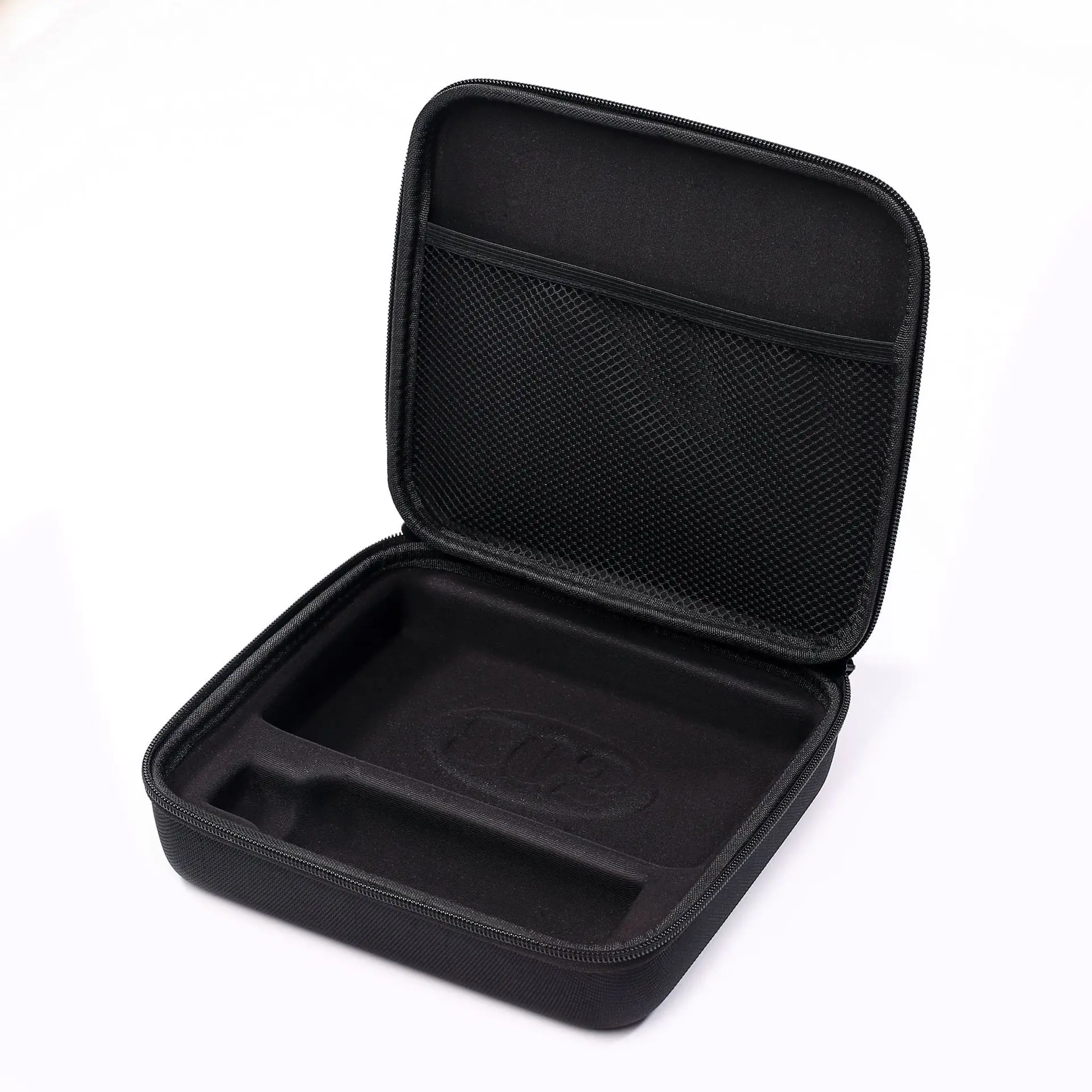
EVA Case Waterproof and Dust Protection: IP Ratings, Sealing Structures and Field Testing for Equipment Programs
What the Two Digits Actually Mean
An IP rating under IEC 60529 is a two-digit code, and each digit is certified independently. The first digit describes protection against solid objects and dust. Level 5 means dust-protected: ingress is not fully prevented, but dust that does enter does not interfere with satisfactory operation. Level 6 means dust-tight, with no ingress at all after eight hours in a talcum-powder chamber under vacuum. The second digit covers water. Level 4 is splash from any direction, level 5 is a 6.3 mm nozzle jet at 12.5 litres per minute, level 6 is a far harsher 12.5 mm jet at 100 litres per minute, and level 7 is temporary immersion to one metre for 30 minutes. A code such as IPX5 simply means the solid digit was not tested.
Two points are routinely missed. First, IP67 does not imply IP66 — a case can pass a static immersion test and still fail a pressurised jet, because the jet attacks the zipper line and mouth geometry with mechanical force that still water never applies. Second, a rating applies to a specific sample configuration, not to a product family. Change the zipper brand, the mesh pocket, the label window or the vent valve and the rating is technically void until retested.
IP54, IP65 and IP67 Compared in Buyer Terms
- IP54 — limited dust ingress tolerated, splash protection only. Realistic for a fabric-covered EVA case with a standard coil zipper and a modest lip. Appropriate for workshop trolleys, indoor tool kits and retail shelves.
- IP65 — dust-protected, jet-resistant. Requires a well-designed mouth shield, a genuinely water-resistant zipper, sealed stitch lines and controlled shell stiffness. Achievable on EVA, but only with deliberate engineering and documented testing.
- IP67 — dust-tight plus immersion. On a zippered soft-sided EVA case this is a stretch. It is more realistically the territory of injection-moulded shells with gasketed closures and latch compression.
Why EVA Cases Rarely Promise High IP Ratings
An EVA case is a compression-moulded foam shell laminated to a textile outer and lined with an interior fabric. Its closure is almost always a zipper running around a three-dimensional curved path. That construction gives you light weight, good impact absorption and excellent branding surface, but it works against airtight sealing in three ways.
Structural Limits Inherent to a Soft-Sided Shell
- No compressive gasket force. A hard case squeezes a rubber gasket between two rigid flanges. A zipper pulls two fabric edges together in shear; it does not compress anything. Any local relaxation becomes a leak path.
- The shell flexes. EVA is chosen because it absorbs shock. That same compliance means the mouth distorts under load, and the distortion opens micro-gaps along the closure line exactly when the case is being carried or stacked.
- Geometry is curved. Corners and radius transitions are where zipper tape lifts, where tape coating cracks, and where a moulded lip loses contact with its mating surface.
This is why the honest industry language is “water-resistant” or “splash-proof” rather than “waterproof”. Water resistance describes performance under a defined, limited exposure; waterproof implies a barrier that survives immersion, and a zippered textile assembly does not deliver that repeatably across a production run.
Shell Fabrics and Surface Water Repellency
PU Leather, Laminated Nylon and Coated Textiles
The outer laminate is the first line of defence and the easiest layer to specify badly. PU (polyurethane) coated leather-look film is the default on most EVA cases: it wipes clean, takes embossing and screen print well, and gives decent initial beading. Laminated nylon or polyester in 600D to 1680D offers better abrasion and tear resistance at similar weight, and it accepts a durable water repellent finish more readily than PU film. TPU laminates sit at the premium end — more flexible at low temperature, more hydrolysis-resistant, and noticeably better at surviving repeated flex without crazing.
What matters is not the face fabric alone but the bonding system. If the adhesive between fabric and EVA foam is water-sensitive, surface water eventually migrates at the edges and the laminate delaminates in bubbles. Specify the peel strength requirement, not just the fabric name.
How Long Repellency Actually Lasts
A factory-fresh DWR finish will bead water impressively in a sample photo. That performance decays. Abrasion from conveyor belts, pallets and vehicle floors removes the finish mechanically; body oils and hand lotion contaminate it; UV exposure and hydrolysis break it down chemically. Most spray-on finishes lose meaningful beading after a few months of real field handling, and hydrolysis is a particular risk for polyester-based PU in hot, humid climates, where the coating can turn tacky and eventually peel.
Treat surface repellency as a first-season cosmetic benefit, not as the sealing mechanism. The functional barrier has to live in the closure, the seams and the mouth geometry.
Water-Resistant Zippers: Types, Cost and Failure Modes
The zipper is usually the single largest leak path on an EVA case, and also the most expensive line item to upgrade. A water-resistant zipper is not a waterproof zipper; it resists the passage of water under splash and light jet exposure for a limited time.
Reversed Coil, Coated Tape and TPU Lamination
- Reversed (invisible) coil. The coil sits on the inside of the tape so the outer face is smooth, with a polyurethane strip bonded along the coil line. Modest cost increase, good splash performance, and the most common choice for mid-range tool and instrument cases.
- TPU-laminated tape. The entire tape is encapsulated in a thermoplastic polyurethane film, so there is no fabric wick path at all. Better jet resistance and much better abrasion life, at a clear cost premium and a slightly stiffer hand feel.
- Coated coil with sealed ends. A spray or dip coating applied over a standard coil. Cheapest option, improves first-day appearance, and degrades fastest under flex.
Common Zipper Failure Patterns
- Capillary wicking at the ends. Water enters at the top or bottom stop and travels along the tape, bypassing the coating entirely. Sealed end boxes and tape-end welding address this and are frequently omitted.
- Coating fatigue at corners. The tape bends hardest where the case mouth turns a radius; micro-cracks form in the film and leak directly through.
- Slider wear. Every cycle abrades the coating on the coil. After a few hundred openings, a zipper that passed the first test will not pass the fiftieth.
- Grit contamination. Dust packed into the coil holds moisture against the coating and accelerates wear, which is why dust protection and water protection must be engineered together.
Stitching, Seam Allowance and Interface Sealing
Every needle hole is a capillary. A standard lockstitch at eight stitches per inch along a case mouth creates a perforation line straight through the outer laminate into the foam. Increasing the seam allowance and reducing stitch density reduces the number of holes, but it does not remove them.
Practical countermeasures: move the structural stitch line away from the mouth and inboard of any drip edge; use a bonded or high-tenacity thread with low wick; apply a heat-activated seam tape over the stitch line on the interior; and specify a bonded interface wherever two materials meet, whether that is fabric to foam, fabric to zipper tape, or foam to a moulded frame insert.
Welded and Taped Seams
Where a panel joint can be designed as a flat, accessible line, high-frequency or hot-air welding removes needle holes entirely and gives a genuinely sealed joint. It works on PU and TPU laminates; it does not work reliably on EVA foam directly or on heavy nylon without a thermoplastic coating. Taped seams over stitching are the pragmatic fallback: cheaper, applicable to curved paths, but dependent on adhesive quality and therefore on ageing performance. If you go the tape route, make the tape specification explicit — width, substrate, activation temperature and peel strength after humidity conditioning.
Case Mouth Geometry: Lips, Drip Edges and Labyrinth Channels
The single most cost-effective sealing upgrade on an EVA case is usually geometric rather than material. A raised labyrinth drip edge — an outer lip that stands proud of the zipper line and overlaps the mating shell — forces water to travel up and over a barrier before it can reach the closure. Combine it with an inner lip that traps any water which does get past, and you have a two-stage path with no added component cost, only mould design.
Design rules that hold up in testing: keep the overlap continuous through the corners rather than tapering it away where the radius tightens; make the lip tall enough to still overlap after the shell has deformed under a stacked load; avoid putting label windows, badge plates or decorative stitching on the outer face of the lip, because each one is a discontinuity; and make sure the lip does not interfere with opening the case, or users will defeat it by leaving the zipper partly open.
Pressure Equalization and Vent Valves
A nearly sealed case is a pressure vessel, and pressure differentials are a routine part of distribution. A one-way or two-way membrane valve lets air move while blocking liquid water and dust, and it solves three problems at once: it prevents a lid from popping open at altitude, it prevents a vacuum from making the case impossible to open after a cold night, and it stops a partially sealed case from drawing moist air inward through the zipper every time the temperature drops.
Why Air Freight Changes the Equation
Cargo holds are typically pressurised to an equivalent of roughly 2,400 metres. A case sealed at sea level on a humid factory floor carries an internal pressure noticeably higher than ambient in flight. Without a vent, that differential loads the zipper line, the bonded seams and the laminate interface from the inside out. In practice, air-freighted cases without vents show a characteristic failure signature: zipper tape lifting near the corners, and delamination starting from the inside of the shell rather than the outside. If your program ships by air, a vent is not an accessory, it is a structural requirement.
Note the trade-off: an immersion test and a vent valve are mutually incompatible. A case with a functioning vent cannot be IP67. Decide which exposure your product actually faces before specifying both.
Test Methods: Spray, Dust Chamber, Short Immersion and Retest After Aging
Testing an assembled case is the only number worth negotiating over. A component certificate for a zipper or a fabric swatch tells you what that material did in ideal conditions; it tells you nothing about the assembly.
- Spray testing (IPX3 to IPX4). Oscillating tube or handheld spray head, defined flow rate and duration, nominally 5 to 10 minutes. Cheap, fast, and a good screening tool for sewing quality.
- Jet testing (IPX5 to IPX6). Nozzle at a specified distance, 3 metres for IPX5 and 3 metres for IPX6 with different nozzle diameters and flow rates, minimum three minutes. This is where marginal mouth geometry fails.
- Dust chamber (IP5X and IP6X). Talc suspended in a sealed chamber for eight hours, with a vacuum drawn on the case interior for the IP6X dust-tight level. Dust chamber testing is the most commonly skipped test and the one that best predicts long-term zipper and coating wear.
- Short immersion (IPX7). Thirty minutes at one metre, with the heaviest point of the case at least 150 mm below the surface. Useful as a safety margin probe even when your target is IPX5, and a clear diagnostic tool: if water enters within two minutes, you have a gross leak; if it enters at minute twenty, you have a wicking problem.
- Retest after accelerated aging. This is the step that separates real programs from brochure claims. Thermal cycling, humidity conditioning, UV exposure, zipper cycle testing and a vibration or drop sequence, followed by repeating the ingress test. A case that fails only after aging is the normal outcome, and the magnitude of that degradation is the honest measure of your design.
Acceptance Criteria and Sampling
Write the acceptance criteria before sampling, not after. Define what counts as a failure — visible droplets, damp indicator paper, or measured weight gain of the internal desiccant pack — define the pass threshold across a sample of at least five to eight units per tooling cavity, and define whether a single failure fails the lot or triggers a corrective-action loop. Also state who pays for third-party verification, because an internal factory report and an accredited laboratory certificate carry very different weight with your downstream customers.
Field Failure Review: Three Recurring Patterns
Adhesive Open-Up, Zipper Wick and Shell Deformation
- Adhesive open-up. A case returns from a tropical market with the outer laminate lifting at the mouth. Root cause is usually a solvent-based adhesive chosen for tack and open time rather than hydrolytic stability, combined with a mouth design that puts the bond line directly in the water path. Corrective action: relocate the bond line inboard, switch to a hydrolysis-resistant adhesive system, and add humidity conditioning to the qualification sequence.
- Zipper wick. Equipment arrives with moisture concentrated at one end of the case, near the zipper stop. The closure itself passed the spray test; the tape ends did not. Corrective action: sealed end boxes, welded tape ends, and a mouth lip covering the stops.
- Shell deformation opening a gap. A case that passed at the factory leaks after being stacked six-high in a container. The shell creeps under sustained load, the mouth bows, and the lip overlap closes to zero. Corrective action: increase shell density or add a moulded frame at the mouth, increase lip overlap, and test under a representative stacking load rather than on a bench.
Impact exposure interacts with all three. A case that has taken a corner drop can distort the mouth enough to break the seal even when nothing visibly cracks, which is why any sealing validation should be run after, not before, the mechanical transit sequence.
Over-Promising: Where Marketing Copy Meets Liability
The commercial pressure to print a high number on a hangtag is real, and the downside is asymmetric. If a case labelled IP65 lets water reach a calibration instrument, the claim sits in your product documentation, your warranty language and your marketplace listing, and it becomes the standard your customer holds you to. Regulators and marketplace platforms treat an unverified IP marking as a substantiation problem, not a technical nuance.
The defensible approach is to publish the tested condition rather than the flattering number: “resistant to water jets per IEC 60529 IPX5, tested on production samples, splash use only, not for immersion”. That is a sentence that survives a complaint. “Waterproof” on a zippered EVA case is not.
Internally, require that any ingress claim on a spec sheet, artwork or listing trace back to a dated test report naming the exact configuration tested — zipper model, fabric, vent, tooling revision. When engineering changes the zipper supplier for cost, the claim must go back to test.
RFQ and Specification Checklist
Use the following list as the sealing section of your RFQ. Every line is something a supplier can quote against, and every line removes an ambiguity that otherwise gets resolved in the supplier’s favour.
- Target rating and test standard. Name the code and the standard edition, and state whether solid and liquid digits are both required.
- Test condition. Which method, which duration, which post-aging sequence, and sample count per cavity.
- Outer laminate. Material, thickness, coating type, hydrolysis resistance requirement, and peel strength to foam after humidity conditioning.
- Water repellent finish. Type, whether it is factory-applied or after-treated, and the required performance after a defined abrasion cycle.
- Zipper specification. Brand or equivalent, coil type, tape construction, coating type, sealed end boxes, cycle-life requirement, and the slider pull style.
- Seam construction. Stitch density, thread type, seam allowance, seam tape specification or welded seam callout, and which seams are taped versus only stitched.
- Mouth geometry. Lip height and overlap, drip edge presence, whether the overlap is maintained through the corners, and permissible distortion under stacking load.
- Pressure management. Vent type, membrane rating, placement, and acknowledgement that a vent precludes immersion ratings.
- Interfaces and openings. Label windows, badge plates, handle mounts, feet, and strap pass-throughs — each is a hole that needs a sealing method.
- Aging and requalification. Conditioning cycles before retest, and the change-control rule that triggers a new test.
- Documentation. Test report format, whether third-party certification is required, and who owns the cost of retesting after any component change.
Programs that specify sealing this way consistently get more accurate quotes, because the supplier is pricing a defined assembly instead of guessing at an aspiration. They also get fewer surprises in the field, which is the only metric that matters once the cases are in customers’ hands.
Tip: never print an IP code on a case or a listing unless you hold a dated test report for that exact configuration — zipper, fabric, vent and tooling revision all included — and re-run the test whenever any one of them changes.
Sealing performance on EVA cases is mostly a design discipline. The material choices matter, but the geometry of the mouth, the treatment of the stitch lines and the honesty of the test protocol decide whether a case protects the equipment inside it for one season or for five.
Related Pages
- EVA Tool Case Purchase Order Guide
- EVA Tool Case Sample Evaluation Guide
- EVA Case Bulk Order Tips
- EVA Tool Case Custom Inserts Design
Ready to source EVA cases with documented sealing performance, validated mouth geometry and test reports you can stand behind? Share your target rating, zipper preference and shipping profile, and our engineering team will return a specification and a sampling plan.
Post time: Oct-19-2026