




EVA Cases for Headphones, Audio Gear and Gaming Peripherals: A B2B Sourcing Guide for Consumer Electronics Brands
Consumer electronics brands live and die by the first thirty seconds after the box opens. A pair of flagship over-ear headphones, a premium TWS charging case, a pocketable DAC, a studio microphone or a handheld gaming console all arrive with a story already written, and the case around them either supports that story or quietly undermines it. For procurement teams the hard part is not finding a factory that can cut foam. It is finding one that understands how a molded EVA case interacts with retail packaging, drop performance, brand color, retail presentation and landed cost at the same time, without asking you to explain it twice.
This guide is written for B2B buyers — sourcing managers, product managers and packaging engineers at consumer electronics brands — who need a practical framework for specifying EVA cases for headphones, audio gear and gaming peripherals. It covers insert design, shell construction, protection testing, portability, branding, tooling economics, compliance and inspection. Where a specific standard or regulation is involved, treat the figures here as a starting point and confirm the current applicable clause with your testing lab or the relevant authority, subject to the latest published requirement.
Why Consumer Electronics Need a Different Case Brief
Tool and industrial cases are usually judged on two things: durability and cost per unit. Consumer electronics cases are judged on three at once: protection, presentation and brand feel. A single pair of flagship headphones can retail between USD 300 and USD 600, and a scuffed or crushed unit rejected at the retail shelf costs far more than the case itself ever will. That single fact reshapes the entire design brief, because the case must now be good enough to be sold beside the product rather than merely transported with it.
- High unit value — the insert must immobilize the product so it cannot migrate, rattle or contact the zipper during transit.
- Scratch and pressure sensitivity — soft-touch coatings, piano-black shells and fabric headbands mark easily, so lining choice matters as much as foam density.
- Custom inserts as standard, not optional — a generic die-cut block is rarely acceptable for retail-bound audio products.
- Retail intent — the case may also be sold as a standalone accessory SKU, which brings hanging cards, barcodes, polybag or box art and color matching into scope.
Category-by-category insert priorities
Over-ear headphones need a shaped cavity that supports the headband and both earcups independently, so the yoke is never loaded in a single direction. True wireless earbuds usually need a shallow tray plus a small compartment for the charging case and spare ear tips, often with a mesh pocket for the cable. Portable DACs and headphone amplifiers are box-shaped, dense and heavy for their size, so they need a snug pocket with a controlled pull tab rather than a loose tray. Microphones, especially large-diaphragm condenser models, are shock-sensitive and normally travel in a dedicated foam nest with the shock mount packed separately. Game controllers and handheld consoles need drop protection concentrated at the corners and grip points, which is where most accidental damage actually occurs.
Insert Design: Die-Cutting, CNC Routing, Lining and Layering
Insert design is where most of the perceived quality is created or lost, and it is also where buyers most often accept a vague drawing instead of a real prototype. There are two primary manufacturing routes: die-cut EVA layers laminated and stacked to the required depth, and CNC-routed cavities milled from a thicker EVA block.
- Die-cutting — lower tooling cost, fast at volume, and best for consistent flat profiles stacked across multiple layers.
- CNC routing — no steel die required, ideal for prototypes, low volumes and complex cavities with draft angles.
- Flocking or velvet lamination — a bonded velvet or suede-effect fabric on visible surfaces prevents scratching and reads as premium.
- Magnetic or snap-in retention — small magnets or molded snap features hold the product or the lid insert without compression straps.
- Layered layout — cable channel in the base layer, product cavity in the mid layer, accessory tray in the top layer.
Magnetic retention deserves a deliberate decision rather than a default. A lid insert held by two or three small neodymium magnets feels far more refined than a friction fit, and it removes the risk of the product pressing against the zipper chain when the case is closed and stacked. Where magnets sit close to sensitive audio electronics, confirm acceptable field strength with the product team before committing the design.
Layer count is the quiet cost driver. Each extra layer adds a cutting step, a lamination step and a chance for misalignment, so specify the minimum number of layers that still separates the product from the cable and the accessories. A three-layer build is a common compromise for headphone cases: base for cables, mid for the earcups, top for a small accessory pocket.
Tip: always approve the insert as a CNC-routed or 3D-printed sample with the actual product and cable loaded, because a flat drawing never reveals whether the pull tab clears the lid insert or whether the earcup yoke sits under compression.
Shell Construction: Molded EVA, Surface Fabric and Closure Hardware
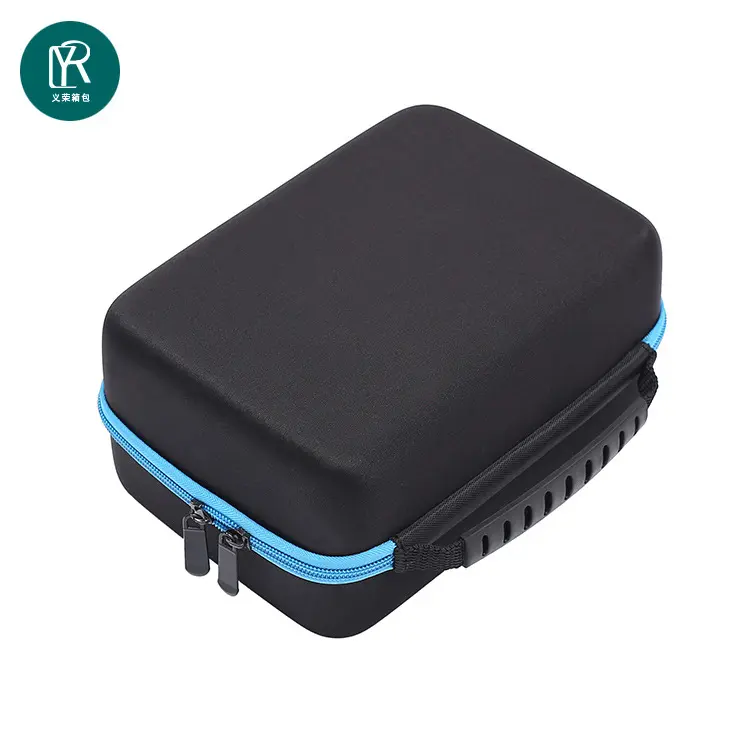
The shell is a compression-molded EVA sheet, commonly 5 mm to 10 mm thick, laminated with a surface fabric on the outside and a lining on the inside, then formed over a mold at temperature. The surface fabric drives both the perceived quality and the abrasion resistance, and it is usually the first thing a buyer touches in a retail environment.
- 1680D ballistic nylon — heavy, textured and highly abrasion resistant, a common choice for gaming accessories and rugged audio gear.
- PU coated fabric — smoother, easier to wipe clean and prints sharply, which suits a minimal retail aesthetic.
- Plain nylon or polyester — lightest and least expensive, usually reserved for entry-level SKUs.
- Ripstop or jacquard weaves — used where a textile brand story is part of the marketing.
Hardness and rebound are set by EVA density together with the molding cycle. Denser foam produces a stiffer shell that resists crushing but feels rigid in the hand; lower density produces a soft, springy shell that absorbs knocks but can deform under a stacked load in a warehouse. For most consumer audio cases a mid-density shell plus a stiffened lid panel is the balance point, and the lid is the panel that fails first when a carton is over-stacked.
Zipper selection should follow the opening radius rather than habit. A tight curve on a compact earbud case needs a shorter pitch zipper, or the slider will bind at the corners and the pull will feel gritty. Corrosion-resistant sliders and a reinforced zipper guard reduce returns in humid markets. Where a zipper is not appropriate — for example on a rigid hinge-design shell — a snap or side-release buckle with a hinge panel is a workable alternative, though it exposes the contents to dust more readily.
Compression and Drop Protection: In-Box Versus Carry
There are two distinct protection scenarios and they should never share a single test plan, because they load the case differently.
- In-box and transit protection — the case sits inside a master carton and must survive stacking, pallet handling and parcel sorting.
- Carry protection — the consumer uses the case daily, so it must survive drops onto hard floors and compression inside a backpack.
Common practice is to define a drop height and drop surface based on the loaded weight of the product and the intended market, then test corners, edges and faces of the loaded case in sequence. Compression testing typically applies a defined load for a defined duration and then checks for permanent deformation and lid separation. Specific limits vary by destination market and by the retailer’s own packaging requirements, so treat any number as a starting point and confirm the applicable clause with your testing lab; where a standard is cited, verify the current version, subject to the latest published requirement.
Two design choices move the result more than anything else. First, keep the product below the zipper line so a stacked carton cannot transfer load through the zipper chain into the shell. Second, place corner reinforcement or a double-wall panel at the points that meet the floor first, since edge drops concentrate energy at exactly those locations.
Portability and Ergonomics
Handles, clips and straps are small parts with a large influence on returns. A molded handle stitched through the shell wall can pull out under load, while a handle anchored to a reinforced internal panel will not. Carabiner loops and webbing attachment points let the case be clipped to a backpack, which matters a great deal for gaming handhelds and portable audio that travel outside a dedicated bag every day.
- Molded EVA handle with internal reinforcement rather than surface stitching alone.
- Webbing loop or D-ring for carabiners, lanyards and aftermarket straps.
- Detachable shoulder strap for larger multi-device cases carrying a console plus accessories.
- Footprint sized to standard backpack side pockets and airline carry-on assumptions, not chosen purely for aesthetics.
Ergonomics also covers the opening behaviour. A case that falls open past 180 degrees feels unstable in the hand, and a lid with no hold-open feature makes one-handed access awkward for a consumer standing on a train. Specifying a hinge stop or a light magnetic hold-open is a cheap refinement that shows up directly in accessory reviews.
Branding: Logo Technique, Color and Retail Presentation
Logo application is often decided late in the program and then costs schedule time. The main routes are debossing or embossing formed into the EVA or fabric, silk-screen printing, heat-transfer printing, woven labels and metal nameplates.
- Deboss or emboss — durable and subtle, works well on PU and fine fabrics, but offers limited fine detail.
- Silk screen — good for flat single-color logos, though less durable on high-wear surfaces.
- Heat transfer — sharp multi-color artwork, best on smooth coated fabrics.
- Metal nameplate — highest perceived value, adds weight and an extra bonding step.
For brand color, agree Pantone references and the substrate before tooling begins. The same Pantone reads noticeably differently on 1680D nylon, on PU and on the raw EVA edge, and separate dye lots will drift from each other over a long production run. Approve a swatch on the actual production fabric, set a Delta E tolerance with your brand team, and keep a retained reference sample at the factory. Retail hanging cards, barcodes and polybag or box art should be specified at the same time as the case, so the accessory SKU arrives shelf-ready rather than as an unfinished project.
Tooling, MOQ and Cost Structure
EVA case tooling normally consists of a molding tool for the shell plus either a steel die or a CNC program for the insert. Die-cutting dies are the cheaper route and pay back quickly at volume; CNC routing avoids die cost entirely but carries a higher processing time per unit and therefore a higher unit price at scale.
- Sampling — usually a handmade or CNC-machined prototype first, followed by a pre-production sample built from the tooling.
- MOQ — driven by fabric minimums, die setup and molding runs; expect a lower MOQ with a CNC insert and standard fabric, and a higher one for custom fabric colors.
- Insert changes — revisiting a die or a CNC program after approval is a real cost and a real delay, so lock the insert geometry before tooling where possible.
- Platform sizing — designing one shell to accept several insert variants spreads tooling across SKUs and shortens time-to-market for the next product in the range.
Platform sizing is the single most useful cost lever in a consumer electronics program. Headphone brands that launch a new model every season rarely want a fresh mold each time, so a shell family that accepts updated inserts lets the brand refresh a product line while reusing a shared molding tool and a shared carton specification. Ask the factory which dimensions are tied to the tool and which are free, because that answer determines how much of your roadmap is locked in.
Environment and Compliance
Buyers increasingly ask about VOC content and restricted substances in fabrics, adhesives and coatings. EVA itself is widely used in consumer goods, but the lamination adhesive and the surface finish are usually where the compliance questions focus, because adhesives and coatings carry the solvents. REACH-style restrictions and equivalent market-specific rules apply to certain substances, and the exact lists and limits change over time, so confirm what applies to each destination market directly with your supplier and your testing lab.
Recycled and bio-based content options exist for fabrics and for some foam grades, but availability, color range and consistency vary widely between mills. Ask for documentation rather than a verbal claim, and be careful not to overstate recycled content in your own marketing before you hold the certificate in hand. Where a claim matters commercially, tie it to a named material and a document you have actually received.
Inspection and Common Defects
Inspection should be carried out on the loaded case, not the empty one, because most real defects only appear once the product is inside and the lid is closed.
- Delamination — bubbling or lifting at the shell edge or between insert layers; check after a short heat or flex exposure, not only straight off the line.
- Insert lifting — the die-cut layer curls away from the shell wall; inspect corners and the base layer, which fail first.
- Zipper binding — run the full travel in both directions, then repeat with the product loaded.
- Color variation — compare against the approved swatch under standardized lighting rather than factory floor lighting, which hides drift.
- Stitching defects — skipped stitches, loose tension, and needle damage on coated fabrics.
- Logo registration and depth — misregistration against approved artwork and inconsistent emboss depth across the run.
Agree the AQL, the inspection points and the defect definitions before bulk production starts. A clear written definition of what counts as a defect prevents the two most common disputes in this category: arguing about a color that was never formally approved, and arguing about a zipper that behaves differently under load than it did on an empty sample.
Sourcing Checklist
- Product dimensions and weight, plus the loaded case weight.
- Insert concept: die-cut or CNC, number of layers, lining type, retention method.
- Shell: EVA thickness, density, surface fabric, closure type.
- Protection target: drop height and surface, compression load, applicable clause confirmed with the lab.
- Portability: handle, loops, strap, target backpack fit.
- Branding: logo method, Pantone references, Delta E tolerance, retail card and packaging.
- Commercial: MOQ, tooling cost, sampling lead time, insert-change policy.
- Compliance: VOC and restricted substance documentation for fabric and adhesive.
- Quality: AQL, inspection points and defect definitions agreed before bulk.
FAQ
What EVA thickness is typical for a headphone case?
Most over-ear headphone cases use a 5 mm to 10 mm molded EVA shell, with a stiffer lid panel or a second layer where the case is expected to be stacked in a warehouse or carried in a crowded bag.
Can CNC routing be used for insert changes after tooling?
Yes. CNC routing is the usual route for prototyping and for low-volume runs where a steel die is not justified. Higher volumes normally migrate to die-cutting once the geometry is frozen.
How do you stop the product from touching the zipper?
Design the cavity so the product sits below the zipper line, or add a lid insert that holds the product down. Both approaches should be verified with the actual product loaded, not on an empty sample.
What is a realistic MOQ for a custom EVA case?
MOQ depends on fabric choice, die setup and molding runs. Custom-colored fabric typically pushes MOQ up, while standard fabric combined with a CNC insert allows lower volumes for a first production run.
How should Pantone matching be handled for EVA cases?
Approve the color on the actual production fabric under standardized lighting and set a Delta E tolerance with your brand team. The same Pantone reads differently across nylon, PU and the raw EVA edge material.
Related Pages
- EVA Tool Case Purchase Order Guide
- EVA Tool Case Sample Evaluation Guide
- EVA Case Bulk Order Tips
- EVA Tool Case Custom Inserts Design
Post time: Oct-14-2026