




EVA Cases for Musical Instruments and Pro Audio Gear: Sourcing for Instrument Brands, DJ Equipment Makers and Rental Companies
Musical instruments and professional audio equipment occupy a difficult middle ground between fragile electronics and high-value, irregularly shaped hardware. A guitar pedalboard, a condenser microphone, a compact digital mixer, a wireless in-ear monitor system, a foldable controller, and a tangle of XLR, TRS and USB-C cables rarely share a single protective profile. For instrument brands, DJ equipment manufacturers, pro audio OEMs and event rental houses, the case is not an afterthought. It is part of the product experience, part of the logistics cost, and part of the brand impression a customer sees before they ever plug anything in. This guide walks through how to specify EVA cases for musical and audio applications, where the real cost hides, and what to confirm before a production order goes out.
Why Instrument and Pro Audio Gear Needs Purpose-Built Protection
Drop, impact and transit shock
Most damage to audio gear in the field is not caused by a single catastrophic fall. It is caused by cumulative low-height drops, loader handling at venues, stacked cases shifting in a van, and gear sliding inside an oversized compartment. A microphone with an exposed capsule, a mixer with a row of faders, or a synth with a brittle encoder knob will not survive a loosely padded soft bag. EVA shells resist compression and rebound better than fabric, and a well-tuned liner keeps the unit from moving more than a few millimeters in any direction. The protection goal is not to make the case bombproof, but to keep the device stationary and distribute localized impact across the shell.
Humidity, condensation and climate swings
Touring gear moves between cold truck holds, hot stage lights, outdoor festivals and air-conditioned hotel rooms. Condensation forms when cold equipment enters a humid room, and that moisture settles on metal connectors and circuit boards. While EVA itself is closed-cell and does not absorb water, the liner and any fabric pockets can trap humidity against the device. Specifying a moisture-tolerant liner and a case that seals reasonably well reduces the risk of corrosion on XLR pins and potentiometer shafts during multi-day tours. For coastal or tropical markets, requesting a mild antimicrobial treatment on the liner is a low-cost insurance against mold during long transit.
Cables, adapters and small accessories need their own zones
The most common rental complaint is missing accessories: a power supply, a single TRS cable, a mounting bracket, a USB dongle. A good case design separates the main unit from its consumables. A lid pocket for cables, a molded tray for power bricks, and elastic loops for inline adapters mean the kit comes back complete. For DJ controllers and small mixers, a flip-up lid compartment that holds a laptop power brick and a USB hub is a frequent, high-value addition. Without dedicated zones, accessories migrate to the bottom of the case, get crushed, and disappear before the next event.
Choosing EVA Density and Liner Construction
EVA is not a single material. It is a family of copolymers whose hardness, rebound and density change with formulation. For musical and audio gear the typical range lands between a softer travel-grade shell and a rigid protective shell, and the liner choice matters as much as the outer density. Buyers should treat shell and liner as two separate specifications rather than one vague “EVA case” line item.
CNC routed foam vs molded-in cavities vs swappable inserts
Three liner approaches dominate, and each fits a different order profile:
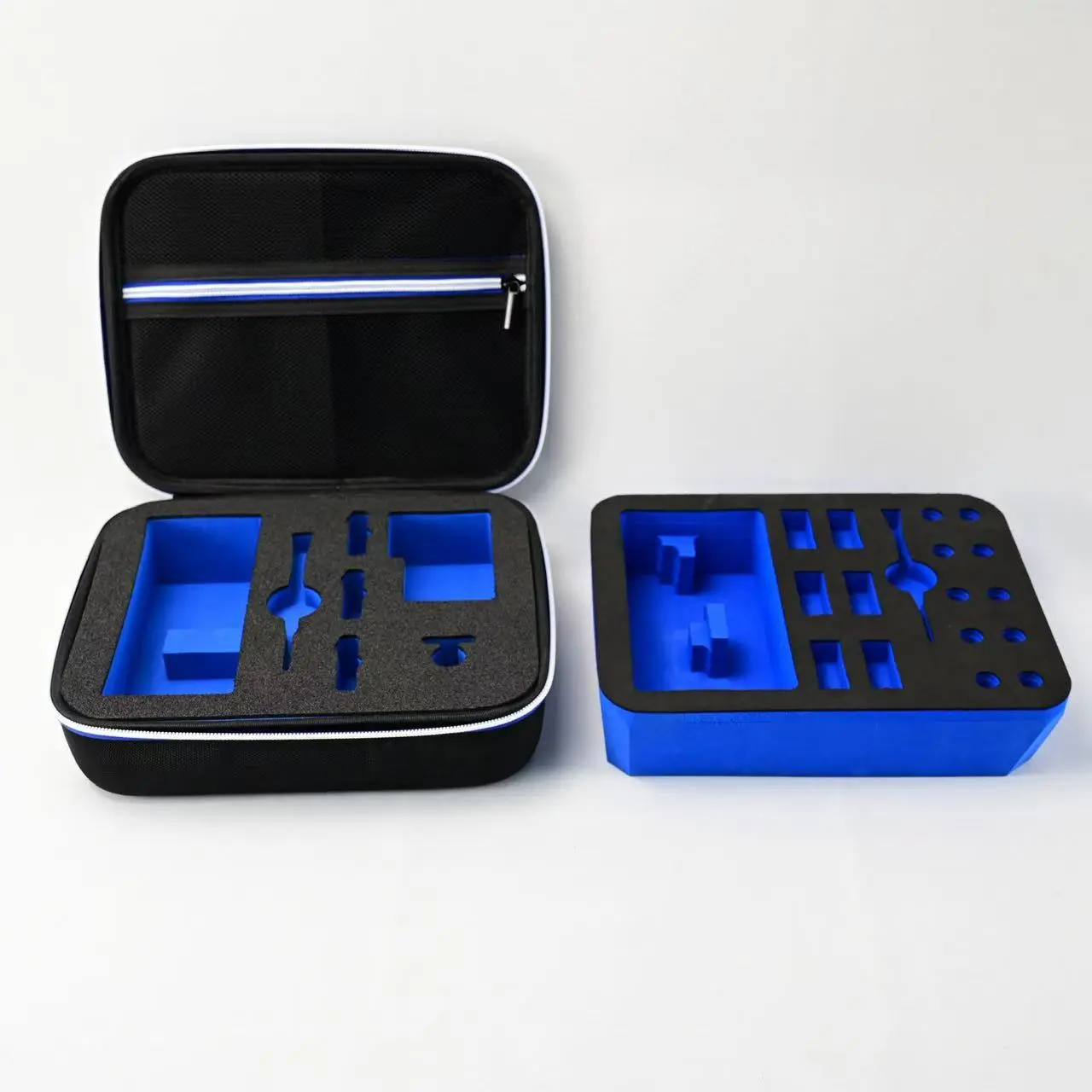
- CNC routed foam uses a sheet of cross-linked polyethylene or EVA foam cut on a router to the exact outline of the device. It gives the tightest, most premium fit and is ideal for a flagship mixer or a signature microphone. Tooling is minimal, so it suits low-to-mid volumes and frequent design changes.
- Molded-in cavities are formed directly into the EVA during compression molding. They are cheapest at very high volume but lock you into one shape; any product revision means a new mold. Best for stable, long-life SKUs such as a standard DI box or a fixed-format audio interface.
- Swappable inserts use a generic diced or pick-and-pluck foam block the end user can reconfigure. This is popular for rental houses that rotate different gear through the same shell, though it looks less finished than routed foam.
For most instrument brands and pro audio OEMs, we recommend CNC routed foam for the first production year and a move to molded cavities only after the product shape is frozen and volume is proven.
The following table summarizes the trade-offs buyers should weigh before committing to a liner method:
| Liner method | Best volume | Tooling cost | Fit precision | Change flexibility |
|---|---|---|---|---|
| CNC routed foam | 200 to 5,000 pcs | Low, no mold | High | Very high |
| Molded-in cavity | 10,000 plus pcs | High, steel mold | Medium | Low |
| Swappable diced foam | Any volume | None | Low | Maximum |
On shell hardness, a 55 to 70 Shore C EVA shell balances rigidity against weight. Softer shells under 50 Shore C flex too much for heavy mixers; harder shells above 75 Shore C add weight and can crack at hinge lines under cold-weather drops. Density in the 0.18 to 0.22 g/cm3 range is a sensible starting point for handheld and tabletop audio gear.
Custom Molds, Odd Shapes and Small-Batch Cost Math
Instruments and audio gear are rarely rectangular. A pedalboard is long and thin. A turntable controller is wide and shallow. A microphone is a cylinder with a fragile head. Each novel outline needs either a new compression mold or a clever routing solution, and the cost difference is significant at low volume.
For a fully custom EVA shell, a steel compression mold typically runs between USD 1,200 and USD 4,500 depending on size, number of cavities and surface detail, with lead time of 25 to 45 days including sampling. For brands ordering under 2,000 units a year, that mold cost amortized across the run adds roughly USD 0.60 to USD 2.25 per case. A practical alternative is a semi-custom approach: take a near-size stock shell and apply routed foam plus a custom-printed lid, which can cut tooling to near zero and bring per-unit cost down by 15 to 30 percent while preserving a branded look.
Break-even thinking matters. If your annual volume is below about 1,500 pieces, avoid a dedicated mold and instead invest the budget in liner quality and print. If you are above 8,000 pieces on a stable shape, a molded cavity pays for itself within two to three production cycles. Between those numbers, the semi-custom route usually wins on both cost and speed.
Zipper and Hardware Specs for Stage and Tour Use
Stage and tour environments are abusive. Cases are dropped, kicked, rained on during load-out, and zipped dozens of times per week. Hardware is where cheap cases fail first, and a single failed zipper can sideline an entire rig on show day.
- Zippers should be a water-resistant zipper with a coated tape and a size 5 or size 8 tooth, preferably with a double slider so the case opens from either end for cable pass-through.
- Stitching at stress points needs bar-tacks or reinforced double rows, not a single straight seam. Pull handles and shoulder straps concentrate force and are the first place a seam blows.
- Hardware should be tested to a minimum of 15 kg static load on a single carry handle and 20 kg on a shoulder strap, with replaceable rivets rather than glued joints.
- Feet and corner guards in TPU or molded EVA extend case life on abrasive stage floors and reduce noise when cases are slid across a riser.
Tip: Always request a zipper-cycle test report with at least 5,000 open-close cycles and a handle-pull test before approving production, because a failed zipper on a tour date is a failed delivery no matter how good the foam is.
Durability and Cleanability for Rental Fleets
Rental companies face a different problem than brands. A sold case is pampered by one owner; a rented case is handled by dozens of strangers, stored in damp warehouses, and returned covered in beer, dust or stage haze. For fleets, cleanability and visual inspection speed outweigh premium finish.
- Specify an anti-soil coated outer fabric or a wipe-clean EVA skin so marks come off with a damp cloth rather than requiring solvents that damage print.
- Use a light interior color or a contrast liner so missing items and liquid spills are visible at a glance during check-in.
- Build a one-page quick-checklist printed on a card clipped inside the lid: main unit, power supply, cables times N, adapters, documents. This cuts write-off losses dramatically across a rotating fleet.
- Avoid velour or brushed liners in rental stock; they hold odors and are impossible to sanitize between events.
Branding Options: Screen Print, Heat Transfer and Woven Labels
Private label and OEM buyers want the case to read as theirs. Three methods cover almost every budget and durability need:
- Screen print is cheapest at volume, gives a crisp logo, and resists fading, but only works on flat surfaces and limited colors.
- heat transfer printing handles full-color gradients and photographic logos, is ideal for short runs, but wears faster under repeated abrasion than screen print.
- Woven labels and rubber badges give a premium, tactile mark and survive the longest, at a higher per-unit cost and a longer lead time.
For instrument brands building a flagship image, combine a woven badge on the exterior with a subtle screen-printed logo inside the lid. For cost-sensitive DJ gear bundled with controllers, a single heat-transfer front logo is usually enough to establish the brand without inflating the bill of materials.
Packaging and Shipping: Box-in-Box and Volumetric Weight
EVA cases are light but bulky, which makes them a volumetric weight problem in air freight. Carriers bill the greater of actual and dimensional weight, and a poorly packed case can triple the effective shipping cost. Two practices control this:
- Use box-in-box packing: an inner mailer that fits the case tightly, inside an outer carton with minimal void fill, so the carton dimension matches the product rather than the case’s rounded corners.
- Flatten or nest where possible, and cap carton height to standard pallet layers to avoid wasted container space and double handling.
For a typical controller case measuring 45 by 30 by 12 cm, tight carton sizing can shave 0.5 to 1.0 kg off the dimensional weight per unit, a meaningful saving across a 2,000-unit sea-and-air split shipment. Always ask the supplier for the declared carton size and the resulting volumetric weight before quoting freight to your distributor.
Sample Confirmation Checklist
Before releasing a production purchase order, confirm the following on the pre-production sample:
- Device seats with less than 3 mm play in every axis and does not touch the shell wall under a 1 m drop simulation.
- Liner material and density match the approved swatch; color and rebound are documented in the spec sheet.
- Zipper runs full length without snagging and the double slider meets at the correct seam.
- Print position, size and Pantone reference are within tolerance on both sides of the case.
- All accessory pockets hold the specified items with the lid still closing flush.
- Handle and strap attachment points survive a 1.5 times rated load hang test for 60 seconds.
- Carton size and pack quantity per carton are confirmed and palletized for a trial shipment.
Procurement Decision Checklist
Use this consolidated checklist when comparing suppliers for a musical or audio EVA case program:
- Confirm the supplier has experience with audio and instrument cases, not only generic tool cases, and ask for two relevant references.
- Lock shell hardness, liner method and density in the technical specification, not just a photo.
- Get mold cost, amortization volume and lead time in writing, plus the price break points at 1k, 5k and 10k units.
- Require zipper-cycle and handle-pull test reports as part of first-article approval.
- Agree on a cleanability and odor standard if the buyer is a rental company.
- Define branding method, placement and Pantone, and approve a printed strike-off before mass print.
- Confirm carton dimensions, pack quantity, pallet layout and declared volumetric weight.
- Set a clear sample-to-production timeline with one revision round included in the quoted price.
FAQ
Can one EVA case fit multiple guitar pedal models?
Yes, using CNC routed foam with a shared base tray and swappable top cutouts, or a diced-foam insert. For a unified brand look across a pedal line, keep the outer shell identical and vary only the liner cut and the lid print so the family reads as one series.
Is EVA enough for flying with fragile microphones?
For checked baggage, pair a rigid EVA shell with a thick routed foam and a hard protective insert around the capsule. Many touring acts use an EVA case inside a larger flight case for the most delicate condensers, and declare the contents as fragile at check-in.
How fast can a custom audio case go from drawing to sample?
A semi-custom routed-foam case can sample in 10 to 15 days. A fully molded custom shell needs 30 to 45 days including mold making. Plan tooling lead time into any product launch calendar so the case arrives before the first shipment of units.
What liner best resists stage odor and humidity?
Cross-linked PE foam with a closed-cell skin and a light color resists odor and wipes clean. Avoid open-cell or fabric liners in rental stock exposed to sweat and smoke, because they retain smell and cannot be fully sanitized between events.
Do rental companies need different specs than brands?
Generally yes. Rental buyers prioritize cleanability, high-visibility interiors, reinforced hardware and quick-check cards, while brands prioritize finish, branding and shelf appeal. Align the specification to the actual use case before requesting a quote, because the two profiles pull in opposite directions on cost.
Related Pages
- EVA Tool Case Purchase Order Guide
- EVA Tool Case Sample Evaluation Guide
- EVA Case Bulk Order Tips
- EVA Tool Case Custom Inserts Design
Ready to source EVA cases for your instrument brand, DJ gear line or rental fleet with a tested liner and hardware spec?
Post time: Oct-12-2026