




EVA Laptop and Tablet Sleeves: Impact Protection Grades, Sizing Tolerance and Retail Program Specs for CE Brands
Why Laptop and Tablet Sleeves Belong on the 3C Accessory Shelf
A 14-inch business laptop retails between 900 and 2,400 USD, yet most buyers ship it in a thin neoprene pouch that offers almost no side-wall crush protection. That gap is the commercial opening for CE accessory brands and electronics retail buyers. Laptop and tablet sleeves are a replenishable, low-ticket, high-frequency 3C attachment category: the device is bought once, but the sleeve is lost, washed out, re-gifted, or replaced every 18 to 30 months. For a distributor carrying chargers, hubs, and cables, the sleeve is the one soft-goods SKU that sits next to the hero device and converts at the point of sale.
The category also fits gift-channel procurement better than rigid cases. A 280-gram EVA sleeve folds flat for warehouse stacking, ships at 6 to 9 USD landed cost in mixed containers, and carries a brand print that survives 200 plus retail handlings. Compared with a molded hard case that needs 4 to 6 cm of shelf depth, a sleeve occupies under 2 cm and lifts shelf density by roughly 3 times. For private-label programs the math is simple: CE brand program margins improve when the attachment SKU carries a 55 to 70 percent gross margin at a 7.90 to 12.50 USD SRP.
- Replenishment cycle of 18 to 30 months keeps repeat POs predictable for 3C buyers.
- Flat form factor cuts warehouse cube cost versus clamshell hard cases.
- Sleeve prints survive 200 plus retail handlings without peeling.
- Gift and premium channels accept sleeves at 9 to 15 USD FOB without custom tooling.
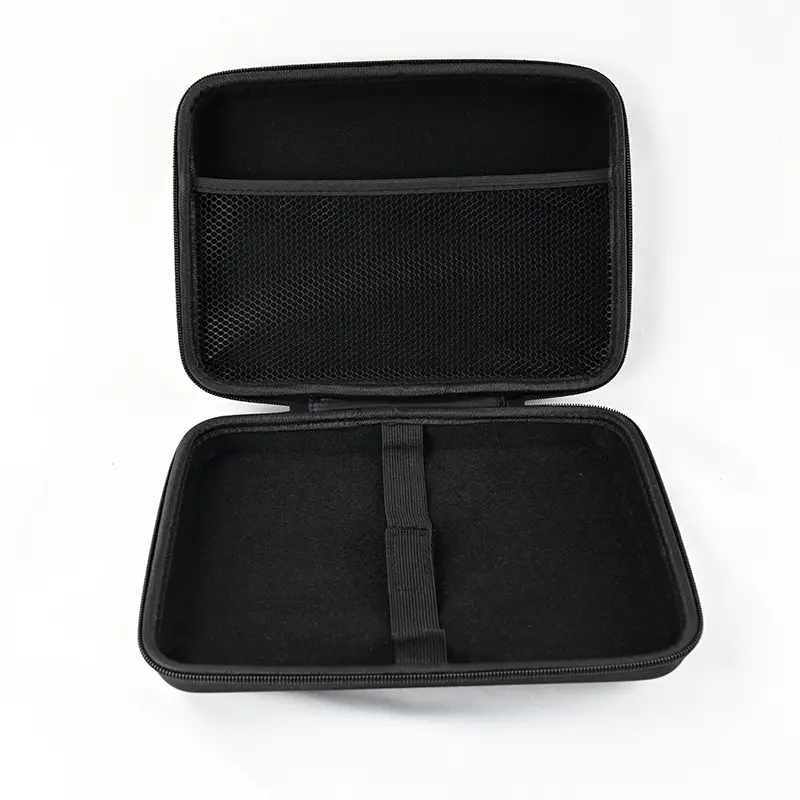
EVA Density and Impact Grade — What “Drop Safe” Actually Means
Not every EVA sleeve protects the same way. The core is a closed-cell EVA foam sheet, and density is the first number a buyer should lock. Standard protective sleeves use 33 to 45 kg/m³ EVA; premium shock grades run 50 to 70 kg/m³. Higher density raises energy absorption but also wall thickness and unit weight, so the spec is a trade-off, not a chase for the biggest number.
Impact grade is expressed by a rated drop height and an energy-absorption figure. A Grade B sleeve is validated at a 0.6 m drop onto concrete with the device in a 1.2 kg test mass, absorbing roughly 60 to 70 percent of impact energy. A Grade A sleeve is validated at 1.0 to 1.2 m with the same mass and absorbs 78 to 85 percent of energy at the contact face. The difference comes from a dual-density laminate: a 4 mm firm outer layer (55 kg/m³) bonded to a 6 mm softer inner layer (38 kg/m³) that compresses on impact and rebounds. Buyers specifying impact protection grade should ask for the drop-test report showing peak g-force at the device corner, not just a pass/fail stamp.
- 33 to 45 kg/m³ EVA: standard daily-commute protection, thinnest wall.
- 50 to 70 kg/m³ EVA: shock grade for field and travel use.
- Grade B: 0.6 m drop, 60 to 70 percent energy absorption.
- Grade A: 1.0 to 1.2 m drop, 78 to 85 percent energy absorption.
- Dual-density laminate spreads the shock across two foam layers.
Sizing Tolerance for 10 to 17 Inch Devices
A sleeve sold as “fits 13.3 inch” must actually fit a 13.3 inch laptop, and the tolerance is where most cheap sleeves fail. The internal cavity is cut to the device footprint plus a clearance margin; a typical spec is device length plus 6 to 10 mm and device width plus 4 to 8 mm. For a 13.3 inch laptop at 307 by 214 mm, the cavity should measure 315 by 222 mm, giving 4 mm per side of slip room so the zipper does not press the lid.
Wall thickness margin matters for the protective claim. A 2 mm EVA wall protects against scuffs; a 4 to 6 mm wall is needed for the Grade A drop rating above. Tablet sleeves run smaller: a 10.9 inch iPad cavity is cut to 255 by 185 mm with a 3 mm zipper channel offset. For 15.6 and 17.3 inch devices, the cavity grows to 385 by 265 mm and 415 by 285 mm, and the wall must stay at 5 mm minimum or the side panels buckle in a stacked carton. Specifying sizing tolerance at plus 6 to 10 mm length and plus 4 to 8 mm width keeps returns under 2 percent across mixed device batches.
- 13.3 inch laptop: cavity 315 by 222 mm, 4 mm per-side slip clearance.
- 10.9 inch tablet: cavity 255 by 185 mm, 3 mm zipper offset.
- 15.6 inch laptop: cavity 385 by 265 mm, 5 mm minimum wall.
- 17.3 inch laptop: cavity 415 by 285 mm, reinforced side panels.
- Tolerance band of plus 6 to 10 mm length prevents lid-pressure returns.
Interior Lining — Microfiber/Velvet vs Mesh
The lining touches the device every time it slides in and out, so the choice is a scratch decision, not a cosmetic one. Microfiber and velvet linings rate 0.8 to 1.2 on the Taber abrasion scale at 200 cycles with near-zero fiber transfer, which is why premium CE brands default to them for aluminum and matte-finish laptops. They also trap less dust than knit mesh.
Mesh lining is lighter and cheaper, at 0.4 to 0.6 USD less per unit, but its raised grid can mark a soft-coated screen if the device is inserted corner-first. For anti-scratch assurance on premium programs, specify a brushed velvet at 120 to 160 g/m² bonded to the EVA with a flame-laminated film rather than spray adhesive, which bubbles after 6 months of heat cycling. Mid-tier retail SKUs can use 210D microfiber at 90 g/m² as the cost-balanced option.
- Velvet 120 to 160 g/m²: best scratch safety, premium CE default.
- Microfiber 90 g/m²: balanced cost and wipe-clean surface.
- Mesh: 0.4 to 0.6 USD cheaper but higher scratch risk on soft coatings.
- Flame-laminated bond outlasts spray adhesive by 6 plus months.
Zipper Selection and Anti-Scratch Detailing
The zipper is the sleeve’s only moving wear point, and in the laptop context it has to clear the device edge without scoring it. A #5 reverse coil zipper with a plastic slider is the retail standard; the reverse coil keeps the teeth on the outside so the inner track that faces the laptop is smooth. For travel and field grades, specify a water-resistant zipper tape with a PU lamination that holds IPX4 splash rating through 5,000 open-close cycles.
Anti-scratch design lives in the details buyers forget to spec. The inner zipper tape must be bound with a 10 to 12 mm bias strip of the same velvet lining, so the metal slider never contacts the device. A pull-tab longer than 35 mm lets the user close the sleeve one-handed without dragging the slider across the lid. For private-label retail, a debossed logo pull at 18 mm reads as premium without adding a hard clip that could scratch.
- #5 reverse coil zipper keeps teeth away from the device face.
- PU-laminated tape reaches IPX4 through 5,000 cycles.
- 10 to 12 mm inner bias binding shields the device from the slider.
- Pull tab over 35 mm enables one-handed, drag-free closing.
Custom Die-Cut Inserts vs Standard Cavity
A standard cavity sleeve is a flat EVA pocket; a custom die-cut insert adds a molded inner tray that cradles a specific device shape, often with a pen loop and a pocket for a 65W charger. The insert is the cost and MOQ fork in the program. A standard cavity tool runs on an existing cutting die at 0 USD new tooling and a 300 to 500 piece MOQ per size. A die-cut EVA insert needs a new steel-rule die at 180 to 420 USD and lifts the MOQ to 1,000 pieces per SKU because the die is amortized across the run.
For a CE brand with one hero device, the die-cut route pays back when the program sells past 3,000 units, because the insert lifts SRP by 2 to 3 USD and drops return rate by holding the device centered. For distributors serving mixed brands, the standard cavity is the safer 80/20 call. The insert also adds 1 to 2 production steps, pushing unit cost up 0.6 to 1.1 USD depending on pocket count.
- Standard cavity: 0 USD tooling, 300 to 500 piece MOQ.
- Die-cut insert: 180 to 420 USD die, 1,000 piece MOQ.
- Insert lifts SRP 2 to 3 USD and centers the device.
- Insert adds 0.6 to 1.1 USD unit cost per extra pocket.
Retail Packaging — Hang Card, Color Box or Polybag
Sleeves reach the shelf three ways, and the packaging choice sets the FOB and the freight cube. A simple polybag at 0.03 to 0.05 USD keeps the unit flat and is fine for e-commerce and gift-channel bulk, but it carries no brand story at retail. A hang card at 0.18 to 0.30 USD adds a euro-slot and a printed size grid, letting the SKU hang on a hook next to chargers and convert impulse buyers.
A color box at 0.45 to 0.80 USD is the premium route for CE brand programs and large-format electronics stores; it holds the sleeve, a spec insert, and a size-compatibility chart for 10 to 17 inch devices. The trade-off is cube: 50 color-boxed sleeves fill a carton where 120 polybagged units fit. Buyers should match packaging to channel — polybag for replenishment, hang card for hook retail, retail ready packaging box for brand-flagged shelves.
- Polybag 0.03 to 0.05 USD: e-commerce and gift bulk, flattest cube.
- Hang card 0.18 to 0.30 USD: hook retail, printed size grid.
- Color box 0.45 to 0.80 USD: brand shelves, holds spec insert.
- 120 polybagged units fit where 50 boxed units ship.
Private Label Program — MOQ, Tooling and Sampling
A CE brand launching its own sleeve line should budget the program on three numbers: MOQ, tooling, and sampling lead time. Standard private-label MOQ starts at 300 pieces per size and 500 pieces per color; a custom die-cut or custom-print program opens at 1,000 pieces per SKU. New tooling for a bespoke shape runs 300 to 800 USD for the EVA die and 150 to 400 USD for the printing screen, often waived above a 5,000 piece annual commitment.
Sampling moves in two stages. A blank construction sample ships in 5 to 7 working days to confirm wall, lining, and zipper. A printed pre-production sample with the brand logo ships in 10 to 14 working days after artwork sign-off. Production lead time is 25 to 35 days for 3,000 to 10,000 units, stretched to 40 to 50 days near the Q4 peak from September to November. Specifying private label MOQ early lets the factory reserve EVA sheet color and avoid the 15 to 20 day wait that hits late Q3 orders.
- MOQ: 300 per size, 500 per color; custom at 1,000 per SKU.
- Tooling: 300 to 800 USD die, 150 to 400 USD print screen.
- Blank sample 5 to 7 days; printed PPS 10 to 14 days.
- Production 25 to 35 days; 40 to 50 days in Q4 peak.
Bundling with OEM Accessories and Gift Channels
The sleeve sells best when it is not alone. Electronics buyers bundle it with a 65W GaN charger, a USB-C hub, and a braided cable into a “desk kit” that lifts basket value by 18 to 25 USD. Gift channels pair the sleeve with a wireless mouse or a power bank in a holiday gift set at 24.90 to 39.90 USD SRP, where the sleeve’s print carries the seasonal artwork and the electronics carry the function.
For OEM accessory programs, the sleeve acts as the protective wrap inside a larger kit, cutting the need for a separate rigid box and saving 0.40 to 0.70 USD per kit on packaging. A distributor can also run a “size family” peg strip — 11, 13, 15, and 17 inch sleeves on one hang card rail — so a shopper buys the right size on the spot instead of ordering online and waiting. The bundling logic is consistent: the sleeve is the low-cost, high-margin soft anchor that makes a hard-electronics set feel complete.
- Desk kit with charger and hub lifts basket value 18 to 25 USD.
- Holiday gift set at 24.90 to 39.90 USD SRP pairs sleeve with mouse.
- Sleeve as kit wrap saves 0.40 to 0.70 USD on rigid box.
- Size-family peg strip converts the right size at point of sale.
Frequently Asked Questions
What drop height should a retail laptop sleeve be rated for? For everyday commute and shelf handling, a 0.6 m Grade B rating is enough; for travel and field programs specify 1.0 to 1.2 m Grade A with a dual-density wall.
Can one sleeve fit both a laptop and a tablet? A 13.3 inch sleeve cavity fits most 11 to 13 inch tablets, but a dedicated tablet cavity at 255 by 185 mm protects the thinner device better and avoids lid pressure on the laptop size.
How long does a private-label run take from artwork to container? Budget 10 to 14 days for the printed sample plus 25 to 35 days production, so 6 to 7 weeks door-to-door outside the Q4 peak.
Is mesh lining safe for a matte laptop finish? Mesh can mark soft coatings if inserted corner-first; specify 120 to 160 g/m² velvet for premium devices and reserve mesh for budget SKUs.
What MOQ unlocks free tooling? Tooling is typically waived above a 5,000 piece annual commitment or a 1,000 piece custom-SKU opening order.
Related Pages
- EVA Tool Case Purchase Order Guide
- EVA Tool Case Sample Evaluation Guide
- EVA Case Bulk Order Tips
- EVA Tool Case Custom Inserts Design
Tip: Always request a drop-test video at the rated height before committing to a production PO, because a printed spec sheet does not prove the sleeve survived the fall.
Ready to source EVA laptop and tablet sleeves built to your CE brand’s impact and sizing specs?
Post time: Oct-09-2026